The Mysterious Lifeboat Found on Bouvet Island

Satellite image of Bouvet Island.
Bouvet Island is the most isolated uninhabited place on Earth. When people say "out in the middle of nowhere" about an area where they could potentially walk to civilization, they are not thinking of Bouvet Island. Imagine a place that is nearly covered in ice and surrounded by the coldest ocean in the world and you would have a good idea of what Bouvet Island is like. It is not Antarctica, but Antarctica is the closest piece of land to the island. Bouvet Island is situated between the tip of Africa and the coldest continent on Earth. It is not the sort of place where it is likely you would find yourself shipwrecked. It is hard for even people who know where it is to find it. How is then that an expedition discovered an abandoned lifeboat on Bouvet Island?

Only the most adventurous travelers visit Bouvet Island and only a very unfortunate soul would wind up there in a lifeboat, unless it was a landing craft. Most modern expeditions onto the island are made by helicopter because landing a boat on Bouvet Island is difficult under the best conditions and impossible under average conditions. It is 90% covered in glaciers, under which is an active volcano. The sides of the island are almost all sheer, icy cliffs. Let's put it this way, if you find yourself lost and stuck on Bouvet Island, you will probably be spending the rest of your now short life there with no food and maybe water, if you have something with which to melt ice.

Because of its location, weather researchers have long thought it a great place to put a weather tower. In 1964, Lieutenant Commander Allan Crawford was sent to the island to investigate a new area of the land, created by lava flow ten years prior to the expedition. He and his team landed via helicopter and began checking out the landscape. There, Crawford saw a lagoon with a very strange feature -- an abandoned lifeboat.

Crawford later reported that the abandoned lifeboat on Bouvet Island had no markings on it that would suggest its origins. It also had no motor and no sails. He found the oars on shore, along with a flattened copper tank and a barrel. He was unable to do a thorough search of the area, given the harsh nature of the terrain and the work he had come to do, but what he was able to search of the landscape turned up nothing else. There was no evidence that people had stayed on the island or died on the island. There was nothing.

Two years after Crawford's Bouvet Island expedition, another expedition did a survey of the area around the lagoon. They described the lagoon, but made no mention of a lifeboat, so it must have disappeared by then, but where could it have gone? It is unlikely that another expedition would have retrieved it, as dragging an extra boat back into the water or bringing a lifeboat onto a helicopter are far-fetched scenarios. There is the possibility that it sank into the lagoon. However, without knowing how deep the lagoon is, it is hard to say. All we do know is that Crawford's lifeboat is gone.

As for the origins of the lifeboat on Bouvet Island, no one has come forward to say it was theirs. It could have been left by an expedition, but the lagoon was no more than ten years old, so there is only a small space of time during which the lifeboat could have appeared. Research into who visited Bouvet Island during that ten-year span has turned up nothing about an abandoned boat.

It seems unlikely that the lifeboat came from a shipwreck, as Bouvet Island is a small speck in a vast land-free ocean. Visibility is extremely poor, as well. Then, there is also the question of why the boat was left there at all. Did a shipwreck victim or the victim of a failed expedition die there? If so, why did he not use his boat for shelter? Why did he not camp near the lagoon? Did he camp, but have the traces of his stay been wiped out by the weather? There are just too many unanswerable questions regarding the mysterious lifeboat of Bouvet Island. It seems we will never know if it signified a disaster or if it was simply unable to return to a bigger ship during a successful expedition.

Sources

Dash, Mike, An Abandoned Lifeboat at World's End, retrieved 8/25/11, allkindsofhistory.wordpress.com/2011/02/13/an-abandoned-lifeboat-at-worlds-end


The Bizarre Murder of Bob Crane

Bob Crane
Bob Crane, likely circa 1969.
Robert Crane was a beloved television actor whose real life had a seedy side and whose death baffled his friends, fans and the police. He played the title role of Colonel Hogan in the '60s sitcom "Hogan's Heroes." He played the role from 1965 until 1971, when the series was cancelled. During that time, he left his wife of more than 20 years for his co-star Sigrid Valdis. He also catered to a taste for promiscuous sex and filming it. After the show, he never found the same success he had with "Hogan's Heroes." He instead took up small roles, acted on stage and continued making amateur pornography. He was on tour with a play when he was murdered in Scottsdale, Arizona.

Before becoming a television star, Bob Crane was a popular radio D.J. in L.A. He worked with ultra-famous people like Marilyn Monroe before he himself became famous. Because of this, he was a lady magnet. He was never without a woman willing to sleep with him or have group sex with him and his friends. Whether they were all willing to be videotaped is not clear. Many of them later said that they had no idea he was filming or taking photographs. It was this ability to pick up women and his love of documenting it that led to his friendship with John Henry Carpenter.

John Henry Carpenter was an electronics whiz with the same sexual appetite as Bob Crane. Together, they would pick up women and take them back to hotels, their homes and other people's homes, where they would engage in sexual acts and document it. There is no evidence that they were homosexual, but there were rumors that John wanted more from Bob than he was willing to give. Rumor has it that Bob told John he did not want to continue the friendship a few days before his murder. Carpenter denied it.

On June 28, 1978, Bob Crane was killed in the early hours of the morning. Someone came into his room at the Winfield Place Apartments in Scottsdale, Arizona and beat him to death while he slept. He was hit in the head with a blunt object at least once, most likely twice. He never even had a chance to leave the bed. The killer also wrapped an electrical cord around his neck and tied it there. Some believe this was a message regarding Crane's love of videotaping sex. Another interesting find was a bottle of scotch in the room. According to those who knew him, Crane did not drink scotch. There was no sign of a struggle and no sign of forced entry.

Given the clues at the scene, police believed that Bob Crane knew his killer. It is possible that he let the killer in or that he left the door open for the killer. He may have even fallen asleep with the killer in the room. At the time, Bob Crane was divorcing his wife Sigrid. He also may have had countless enemies in the form of jilted lovers, jealous husbands/boyfriends and angry women who did not know they were videotaped by the star. The list of suspects could have been very long. However, there was no evidence that one of his lovers had anything to do with it. His wife also had an alibi. Sure, she could have hired someone, but someone he knew?

This left police with John Henry Carpenter. He and Bob Crane were inextricably linked in this sordid tale. John got a stream of lovers through his friendship with Bob. He had a lifestyle to lose if Bob were to sever their friendship. The problem with that is there is no evidence they had a falling out--or very little. Police found it suspicious that John called the apartment several times while they were there and never asked why the police were in his friend's apartment. That could be explained by John not wanting to implicate himself if it had something to do with their pornography. Much more difficult to explain is blood found in John's rental car that matched the blood type of Bob Crane. The problem with that is there was no way to test the DNA at the time.

Over the years, John Carpenter was the main suspect in the case, but there was never enough to arrest him. Prosecutors decided to go with a picture of what could have been brain matter in Carpenter's rental car. The picture did not hold up in court and he was acquitted. To this day, he is the go to in this whodunit. There is no single other person who draws so much suspicion in this case, but that could be because the possible list is simply too long and varied to pick one out of the myriad of people with motive.

Sources

Wilonsky, Robert, Klinky Sex, retrieved 11/26/11, sfweekly.com/2001-07-18/Cultural/Klinky-sex

Bob's Cranium, retrieved 11/26/11, findadeath.com/Deceased/c/Bob%20Crane/bob_cranium.htm

Bizarre Stories: Angelique Cottin's Poltergeist Activity

Édouard Isidore Buguet  fakes telekinesis
Édouard Isidore Buguet
fakes telekinesis
Angelique Cottin was the alleged generator of poltergeist activity in France over a few months in 1846. Cottin came from a poor Catholic family who saw her supposed power of manipulating objects as a way to make money. Whether that was the plan all along or the Cottins simply cashed in on their misfortune, no one knows for sure. Either way, it did not help their credibility. Nonetheless, Angelique's story is prominent among stories of alleged poltergeist activity and has yet to be debunked or proven, so it remains a mystery.

Angelique was living near La Perriere, France when the alleged phenomenon started on January 15, 1846. The story goes that she was working silk with a few friends when either the weaving frame or the table on which they worked started shaking. They told adults, but were not believed, so they tried to go back to work. Apparently, it kept happening, but only when Angelique was near the frame or the table, depending on the source.

Note: Small variations in the sources regarding Angelique Cottin may be the result of French to English translations. However, there are large discrepancies of note as well.

Angelique Cottin's parents found out about the occurrence and told people they believed her. They took her to the parish priest for exorcism. Lucky for Angelique, the priest sent her to a doctor instead, obviously believing that the girl was not possessed. Whether he believed her a fraud or someone with a strange illness is unclear.

Interestingly, the doctor allegedly saw objects move quickly away from Angelique Cottin after so much as brushing against her skirt or hand. People near her said they felt electric shocks. Chairs and couches that Angelique sat in were flung against the wall. The doctor's reports supposedly state that men were made to hold down furniture that was affected by Angelique. They were unable to hold it still when her powers were active. There were breaks in the activity, but the doctor said she was most active in the late evenings.

Eventually, the case of Angelique Cottin was referred to academics, one of which was a physicist. They went over the reports given by the doctor, by the girl and presumably by her parents. They made their own report based on these and their own tests. According to some sources, the committee of academics concluded that the phenomenon was genuine and published those findings in the Journal des debats in February of 1846. In truth, the committee observed none of the phenomena described by the doctor and the Cottins save one. They observed the chairs she sat in shaking, though they were never able to ascertain whether the shaking was of her doing. They were going to arrange further tests, but the poltergeist of Angelique Cottin suddenly ceased activity on April 10, 1846. At least, that is what the committee was told.

Despite never returning for follow up experiments with the committee, Angelique continued to display her malady for money. How she was able to replicate it after it supposedly stopped is unknown. Whether she had been faking it and simply continued to do so is also unknown. The biggest unknown here is how she would have faked it. It seems that without either the help or incompetence of her doctor, she would not have been able to pull such an elaborate fast one. Maybe she fooled the doctor. Maybe her parents promised him a cut of the profits. Maybe she was not faking it at all.

It is important to mention that sources regarding Angelique Cottin vary wildly. Some say she could manipulate magnets, though the only claim made at the time was that she could find the North Pole on magnets by touch. There are also some that say she made compass needles spin, though that was never claimed possible by her observers. Contemporary sources are available to peruse for those who are interested. Just don't expect them to shed any light on the subject.

Sources

Haughton, Brian, Angelique Cottin -- Electric Girl, retrieved 11/19/11, mysteriouspeople.com/poltergeist_girl.htm

Figuer, Louis. The Electric Girl, Popular Science Monthly March 1875, Volume 6

Bizarre WWII Weapon: Balloon Bombs

Oregon memorial to the lives  lost due to the balloon bombs
Oregon memorial to the lives
lost due to the balloon bombs
Courtesy of Gary Halvorson
During World War II, Japan and the United States were scrambling to outdo each other on the battlefields, in the air and with surprise attacks on often mostly civilian targets. It started with the Japanese attack on Pearl Harbor, which in turn triggered the Doolittle raids against Japan. Most people believe that the next event that involved a surprise attack was the bombings of Hiroshima and Nagasaki. However, before that occurred, the Japanese bombed American soil over a period of five months.

After the Doolittle raids, the Japanese were looking for a way to retaliate against the United States. They eventually came up with a plan to build thousands of balloons and attach 15-kilogram bombs to them. The balloons and the bombs would then be sent across the Pacific to the United States. The project took nearly two years to complete and required the closing of schools so that children could help in the construction of the balloons, of which there were 9,000 total. The Japanese called these devices Fu-Go weapons.

The first bomb balloons were sent on November 3, 1944. They were specially designed to stay between 30,000 and 38,000 feet in altitude so that they would remain in the jet stream for long enough to reach the United States. They were not equipped with navigational systems and they weren’t capable of guiding themselves. The idea was that they could just ride the jet stream over the Pacific Ocean and to the United States. Nearly one thousand of the balloons actually reached their destination or Canada. What happened to the other eight thousand is uncertain, though it is thought that they simply fell out of the air and into the Pacific.

The bombs that did land in the states did relatively little damage. However, some of the balloons were equipped with incendiary bombs that did cause some forest fires in the northwest United States. The United States government found it wise to cover up the success of the bombing in regards to the media. If the information had reached the Japanese, they certainly would have continued the bombing or possibly modified the balloon bombs to make them more deadly. As it was, they continued sending the balloons until April of 1945 and five people died as a result. The victims were killed when they were picnicking and saw one of the balloons caught in a tree. They attempted to pull the balloon out and the bomb exploded, killing four children and their mother.

There is the possibility that there are live balloon bombs in the United States that haven’t been detected, as of yet. There are still eight thousand balloon bombs that are unaccounted for. Even if it is likely that they fell into the Pacific, there is still a strong chance that some of them made it and are waiting in remote locations.

Sources

Japanese Balloon Bombs, retrieved 10/02/09, japaneseballoonbombs.com


Balloon Bombs: Japan’s answer to Doolittle, retrieved 10/02/09, nationalmuseum.af.mil/factsheet.asp?id=1492

The Anthrax Letters

Letter Envelope
On September 11, 2001, foreign terrorists attacked the United States. Citizens of the United States were shocked, scared and grieving. It was a time of paranoia and distrust. People wondered when and if the country would be attacked again. Then, a matter of days later, something happened that caused nearly everyone to believe that the U.S. was still under attack. A number of letters containing spores of the bacteria that causes anthrax were sent to public figures. People who had been exposed to these letters, or letters that had come into contact with the anthrax letters, began falling ill.

Anthrax is a disease that is caused by the bacteria Bacillus anthracis. It typically affects herbivorous mammals, but can infect any mammal, as far as we can tell, including humans. Most human anthrax infections are caused by contact with infected animals or infected animal byproducts. There are three ways to contract the disease, through open skin, breathing in spores or eating the bacteria. It is not contagious, meaning it cannot be spread from one infected human to another. The bacterium is tasteless, odorless and the amount needed to kill a person is invisible to the naked eye.

Anthrax that is contracted through the skin, or cutaneous anthrax, causes necrosis. It starts as a small bump that escalates into a painless ulcer. This form of anthrax is highly treatable. Only one percent of treated cases of cutaneous anthrax will cause death. The mortality rate is 20 percent for untreated cases.

Anthrax that is contracted through the digestive system can cause a painful death. The symptoms are nausea, vomiting and loss of appetite. Later symptoms include bloody vomit and diarrhea. Twenty-five to fifty percent of people who contract anthrax in this manner will die.

Anthrax that is contracted through the lungs is the deadliest form of the disease. Symptoms start like the common cold and progress to severe difficulty breathing. Eventually it becomes so bad that victims have described the sensation as having your head held under water. Shock is very common in this form of anthrax. Roughly 75 percent of people who contract anthrax through their lungs will die. The Anthrax letters of 2001 caused five deaths. All of them occurred in individuals who had inhaled the bacteria.

According to the F.B.I., there were four letters (there are claims of more, however). The first two were sent on September 18, 2001. Their intended recipients were Tom Brokaw of NBC and the New York Post. Two more were sent October 9, 2001. The intended recipients of these letters were Senators Tom Daschle and Patrick Leahy. All of the letters were mailed from a box in Newark, New Jersey. According to the CDC, 23 people contracted anthrax as a result of these letters; one of them was a baby. Obviously, the person or group was sending these letters did not care who got hurt.

Through handwriting analysis, the F.B.I. was able to conclude that the same person wrote each of the letters. Of course, this did not rule out the possibility that a group planned the attack. The popular (and logical) thinking, initially, was that a foreign terrorist group was responsible for the attack. Authorities knew that they had to uncover the person responsible and fast. Terrorists who are capable of using biological weapons and are not afraid to use them are a scary prospect. However, authorities did not uncover a foreign terrorist group. When it was found that the anthrax came from an American source, the F.B.I. turned their attention to possible domestic terrorists.

The first public "person of interest" in the anthrax letters case was Doctor Steven Hatfill. Hatfill was an Army doctor. He was closely scrutinized by the F.B.I. for quite some time. He was eventually found innocent of any wrongdoing. However, he had been so closely watched that he felt it had damaged his career. He sued the government for invasion of privacy and won.

The next noteworthy "person of interest" in the anthrax letters case was an unassuming Army biodefense expert, Doctor Bruce Ivins. The F.B.I. had concluded that the anthrax causing bacteria had come from his laboratory (experts have since claimed that the F.B.I.'s evidence for this was not conclusive). They subjected Bruce to the same scrutiny that they subjected Steven to. However, they found many things that led them to believe that Bruce was their guy. Bruce had a number of photos of blindfolded women in his computer (circumstantial); later in the investigation, they found correspondence of Bruce's in which he claimed to have multiple personalities (circumstantial); the F.B.I. discovered that Bruce was obsessive about women (circumstantial) and they also listened in on a conversation in which Bruce said that he couldn't remember having mailed any anthrax letters and that he thought (hoped) he wasn't capable of such a thing (decidedly not a confession). Dr. Bruce Ivins committed suicide by ingesting an overdose of Tylenol in 2008. He never confessed to the crimes, nor has direct evidence been found linking him to the anthrax letters.

In February of 2010, the F.B.I. officially closed their investigation into the anthrax letters of 2001. They concluded that Dr. Bruce Ivins was responsible for the letters and that he acted alone. Many people believe that the F.B.I. closed the case prematurely and/or that they based their investigation on preconceived notions. Lawrence Sellin Ph.D., and others, believes that, while it could have been Ivins, the case has yet to be thoroughly investigated. Furthermore, it is the belief of some that Ivins' mental issues (apart from his obsession with women, which hardly makes him a murderer), including his suicide, were a direct result of the investigation.

Read more from the F.B.I.'s investigation here.

Sources

Council on Foreign Relations, The Anthrax Letters, retrieved 5/1/10, cfr.org/publication/9555/#p1

Shane, Scott, F.B.I., Laying Out Evidence, Closes Anthrax Case, retrieved 5/1/10, nytimes.com/2010/02/20/us/20anthrax.html


Questions and Answers About Anthrax, retrieved 5/1/10, bt.cdc.gov/agent/anthrax/faq

The Bizarre Life and Death of Anneliese Michel: A Woman Possessed

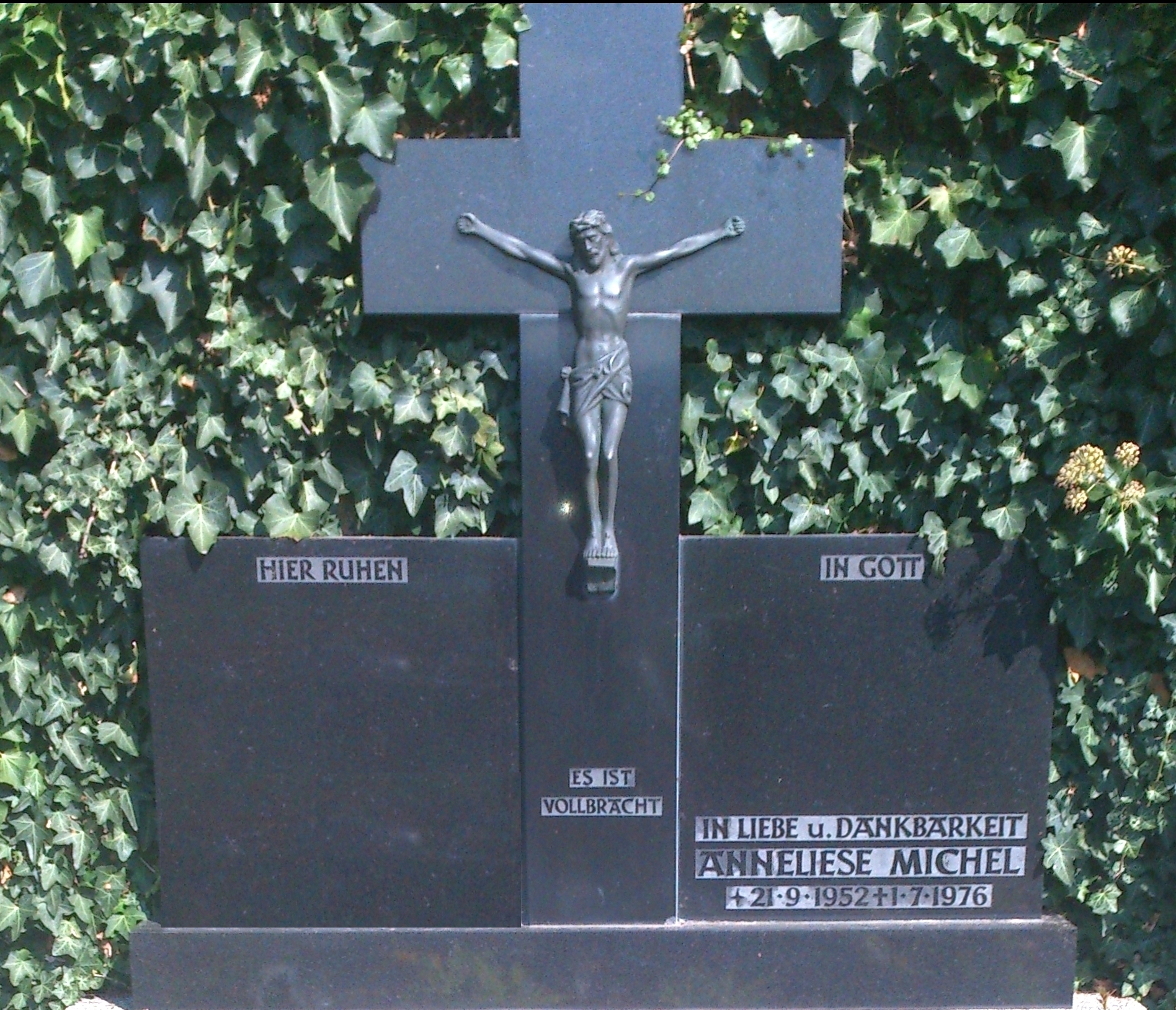
The gravestone of Anneliese Michel
Anneliese Michel was born in Germany on September 21, 1952. She grew up in an arguably extremly Catholic family. Pictures of her taken in her childhood show a vibrant, pretty girl on her way to becoming a gorgeous, healthy woman. She had shining black hair, an open, honest face and a stunning smile. By the time she was 23-years-old, she was emaciated, heavily bruised, scarred and deranged. She was allegedly taken over by demons and fought for nearly eight years before finally losing her battle with evil. Later, her death was labeled negligent homicide, but was there anything anyone could have done for Anneliese Michel? Were those who were with Anneliese really fighting Satan or did her caretakers fail to treat a serious mental illness?

Four years before Anneliese was born, her mother, Anna Michel gave birth to an illegitimate daughter. This was a source of shame for the Catholic family. After she married and gave birth to Anneliese, she apparently harbored feelings of guilt about her first daughter. Unfortunately, Anneliese's older sister died at the age of eight, but Anneliese reportedly felt like she needed to repent for her mother's sin. It is said she spent much of her time doing penance for her mother, sinful youth and bad priests.

Anneliese's symptoms of possession or mental illness began in 1968. Anneliese was a 16-year-old high school student. The symptoms were convulsions and they were eventually diagnosed as epilepsy by a neurologist. Michel took medicine for her condition and continued her life to the best of her ability. She finished high school and went on to college, where she studied to become a teacher. Apparently, the medicine was not helping her much. Her problems only got worse.

Over time, Anneliese complained of seeing disturbing visions while saying her prayers. Later, evil voices giving her commands followed. Finally, Anneliese began showing an aversion to religious iconography. An older woman, a friend of the Michel family, noticed this while on a pilgrimage with Anneliese. She said that Anneliese smelled "hellishly bad" and took her to see some priests. Many of them said Anneliese needed a doctor. However, one said Anneliese needed an exorcism and that exorcism was eventually granted.

In 1975, Anneliese Michel and her parents stopped seeking medical advice and gave over Anneliese's fate to the Roman exorcism ritual. Anneliese, the priests and her parents truly believed she was possessed. Anneliese Michel herself said that Judas, Nero, Hitler, Cain, Lucifer and others were inside of her. Over the next ten months, Father Arnold Renz and Pastor Ernst Alt performed 67 exorcisms on the tormented girl. It is important to note that every action taken during these rituals was condoned by Anneliese. However, most would say her ailment was mental and that she could not have understood what was really happening.

Sometimes, the seriously ill Anneliese would perform hundreds of genuflections during these rituals. It is rumored that her parents held her up for them when she got too weak to do it herself. It is not hard to imagine this being necessary, given that Anneliese stopped eating altogether for some time before she died. She believed it would lessen the evil's control over her. There are claims that Anneliese spoke several different languages (or the demons and evil souls that possessed her did) during the exorcisms. The author of this article cannot verify such claims, as she does not speak the languages Anneliese supposedly spoke in the tapes.

It is certain that medicine was not saving Anneliese Michel from whatever tormented her, but there is no questioning that things got worse for her when she gave herself over to exorcism. In all likelihood, she needed a different kind of medical attention. She allegedly urinated and defecated on the floor frequently, also licking up her own urine. She ate insects, growled at religious icons and sat under her kitchen table barking for two days. Surely, her family was afraid of her, but a medical professional probably would not have left her under the table for two days or let her starve to death, which is eventually what she did.

Anneliese Michel died of dehydration and malnutrition on July 1, 1976. The 23-year-old woman weighed 68 pounds at the time of her death. Josef Michel (her father), Anna Michel and the two exorcists were eventually charged with negligent homicide. During the trial, evidence of the possession worked both for and against the defense. Forty-two of the exorcisms were audio-recorded and there were various pictures of a seriously ill-looking, bruised and sore-covered Anneliese. Anneliese is horrifying in these tapes which might have helped the defense, but is certainly not conclusive. If nothing else, the tapes made it clear that Anneliese was seriously ill and no one was making her eat. It is certain that possessed or not, Anneliese should have been cared for better.

There is no way to prove or disprove supernatural occurrences, such as possession. That makes it difficult to know what really happened to Ms. Michel. However, it is possible to prove that there is some evidence that epileptics are at an increased risk of displaying symptoms of schizophrenia and it is has been posited that Michel suffered from dissociative personality disorder and schizophrenia. That, combined with her religious background, could easily account for the events leading to her death.

Tape of Exorcisms of Anneliese Warning: This is very disturbing

Sources

Questioning the Story, retrieved 4/8/11, chasingthefrog.com/reelfaces/emilyrose.php

Slater, Eliot & Beard A.W., The Schizophrenia-like Psychology of Epilepsy, retrieved 4/8/11, bjp.rcpsych.org

The Ivanov Experiments or Humanzee

Hybrids, when not in the annals of science fiction, are not very intimidating things. We get often-infertile animals like the mule and wholphin from two similar species producing viable offspring. However, there is an interesting realm where few have dared to tread -- human hybridization. This is very intimidating for many. In fact, some are outright enraged at the idea. No matter where you stand on the matter, the truth is that a human and chimpanzee has been hypothesized and the science adds up quite enough that it is not unreasonable to assume it could happen.

In the first half of the 20th century, a Russian scientist named Ilya Ivonavich Ivanov was a successful zoologist. He wasn't just sitting around his lab thinking up insane ways to freak people out. He developed a method of artificial insemination for livestock. His main focuses were to create sturdy hybrids and save endangered species. We do not remember him for that. We remember him for trying to make a human/chimpanzee hybrid.

It seems the first known mention of Ivanov's interest in this "field" came in 1910, when he spoke about it. Over the next 20 years, he worked on the idea off and on. He clearly was never successful, but he did not have a whole lot of support. It definitely couldn't be said that an exhaustive effort was made and it just isn't possible. His efforts were stopped in 1930 when he was arrested based on what seems likes unrelated events during a time of difficult for scientists in Soviet Russia.