Sometimes, there is some fun to be had in analyzing the most bizarre things we can find in history, the present and nature. Among the best lighthearted bizarreness are hoaxes. Sure, they are not so much fun for the victim(s), but, in my opinion, it sure beats writing about murderers and poisonous plants. I lied, I love writing about poisonous plants, but I'm getting off topic. I'm here to tell you about the Berners Street Hoax and that is what I am going to do.
Back in 1810, gentlemen weren't exactly the stiff pains in the butt you may imagine them to have been. At least, Theodore Hook wasn't stiff. He was definitely a pain. He bet a friend, legend has it this friend was Samuel Beazley, that he could turn 54 Berners Street into the most famous home in London in a single week. He won the bet.
On November 27 or 26, depending on the source, the chaos began with a chimney sweep knocking on Mrs. Tottenham's door at 54 Berners Street at a very early hour. She hadn't ordered one, but that didn't stop this service provider and countless others from arriving that day. Before the day was over, people were delivering wedding cakes and pianos, offering condolences for a death that had not occurred and the mayor even arrived to have a meeting with the homeowner, but left when he realized that his summons was a lie. It was an easy assumption to make, given that the street was so crowded as to be blocked and even was officially blocked at one point.
It turns out, Hook had sent between 1,000 and 4,000 letters to the people and workers of London asking them to come to the house under a variety of pretenses. The sheer number of letters points to an accomplice, but exactly who helped him is not certain. In fact, police never even apprehended him in the case. He was suspected, but never arrested. You may say he would have deserved it. No doubt people lost money on the prank, but it is remembered more than 200 years later, so his prank had its merit.

Bizarre Statues Around the World
Before we even get started, I'll admit that there is a bunch of weirdest statue posts on the Internet. I definitely lose points for originality. However, there is none here and I'm catering this list to suit That is Bizarre! You will find that this list is a bit limited in at least one way. I'm not including sexually explicit statues. Most of them aren't really bizarre unless you're a prude. I'm only including ones that I found truly strange, even in context.
1. The Peeing Men in Prague
Okay, this one really isn't called "The Peeing Men in Prague." I'm not really sure what it is called, so I just described it. These men are placed outside of the Franz Kafka museum. This piece is by sculptor David Cerny, who I am relatively sure makes more than one appearance on this list. This certainly is not the first sculpture to use the way men urinate as inspiration for a fountain, but it is an interesting one. The, ahem, spigots on the sculpture will draw out shapes and will even write out texts sent to a specific number.
2. Franz Kafka Statue -- Prague
Well, it appears that Mr. Kafka inspires some very strange sculptures. The man was a master of bizarre stories, but it is not entirely certain what these strange works have to do with him, if anything. This particular sculpture by Jaroslav Rona. Sure, it is loosely based on one of Kafka's stories about a man riding on another man's shoulders, but this one features Kafka himself riding on the shoulders of what looks like a very large, empty suit.
3. "Man Attacked by Babies" Vigeland Sculpture Park
This sculpture in Oslo is a bit alarming, especially without back story. It appears to be a man literally kicking a baby and perhaps having a few more tossed on him from above. Oh, the man is also quite naked. So, he's a jerk, right? Not really. If you look closer, you will see that the babies are horrifically evil in a subtle kind of way. The statue depicts a man being attacked by imps in the guise of babies. That explains why he's trying to kick a field goal with one of them.
4. Babies of Prague
Here we are back in Prague, a place that clearly allows alarming art to litter the streets. Guess what else is back? David Cerna and his seriously creepy aesthetic. The babies are large sculptures found in several places. I'm not quite sure just how many there are, but I do know the best way to see them is from the base of the Zizkov Television Tower. There are many crawling up it so it looks like it is being attacked by mutant children. The best part is their faces or I should say their lack of faces. The heads are fronted by what looks like a rectangular butthole.
5. Bukchon Museum Bench in Seoul
Bukchon Museum in Seoul is a quaint little museum in Seoul, Korea. Just outside of its glass front is a bench that makes for a great photo opportunity. It may be more fun that bizarre, but it certainly is strange. On either end is a large head with exaggerated features and straight, even teeth. Inside of these teeth is clenched the wood of the bench. The effect is two men's heads coming up out of the sidewalk and trying to eat either side of a cracker a la Lady and the Tramp.
(I could not find a public domain or shared photo of this piece. Just Google "Bukchon Museum Bench. Sorry for the inconvenience.)
6. The Child Eater of Bern
Okay, the German name for this sculpture is Kindlifresserbrunnen, but I'm not typing that more than once, so Child Eater of Bern it is. This Swiss sculpture was made by Hans Gieng in the 16th century CE. It features a very colorful ogre or man with a sack full of babies in one arm. The other arm is engaged in shoving one of the children in the ogre's mouth. The ogre is part of a larger statue. There is some mystery as to what it means, as there appears to be no record of the inspiration behind the design.
7. Victoria's Way Indian Sculpture Park in County Wicklow, Ireland
Instead of wading through the strange statues in this park, I'm just going to invite you to Google it and see what pops up. I think you will be hard pressed to find a single statue that isn't bizarre inside of the park.
(None of the photos I could find of this park in the public domain were cool enough. Again, just use Google. I hate to make you do it, but the alternative is worse.)
1. The Peeing Men in Prague
Okay, this one really isn't called "The Peeing Men in Prague." I'm not really sure what it is called, so I just described it. These men are placed outside of the Franz Kafka museum. This piece is by sculptor David Cerny, who I am relatively sure makes more than one appearance on this list. This certainly is not the first sculpture to use the way men urinate as inspiration for a fountain, but it is an interesting one. The, ahem, spigots on the sculpture will draw out shapes and will even write out texts sent to a specific number.
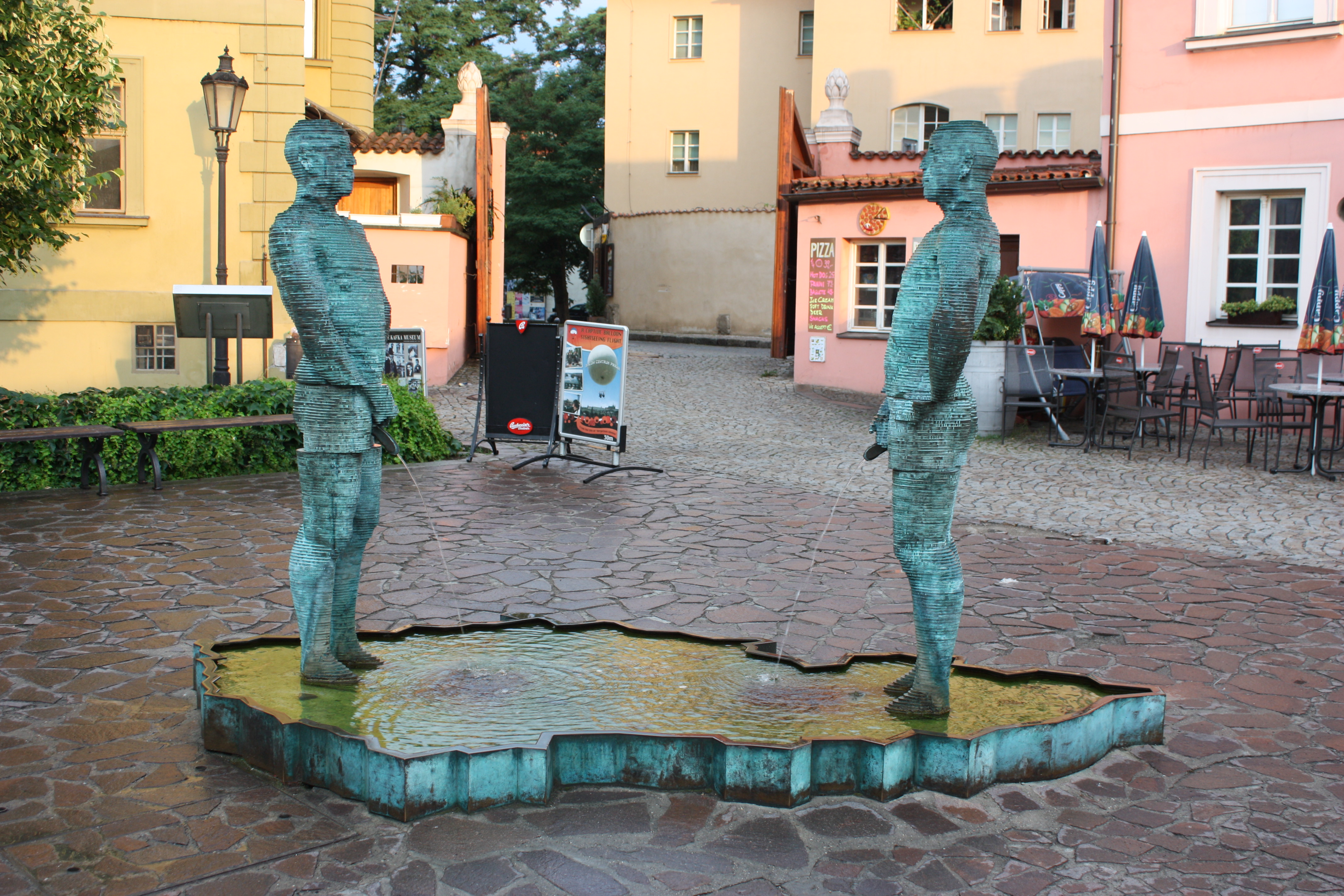 |
| "P*ssing Men Statue" by David Cerna
Courtesy of Kenyh Cevaron
|
2. Franz Kafka Statue -- Prague
Well, it appears that Mr. Kafka inspires some very strange sculptures. The man was a master of bizarre stories, but it is not entirely certain what these strange works have to do with him, if anything. This particular sculpture by Jaroslav Rona. Sure, it is loosely based on one of Kafka's stories about a man riding on another man's shoulders, but this one features Kafka himself riding on the shoulders of what looks like a very large, empty suit.
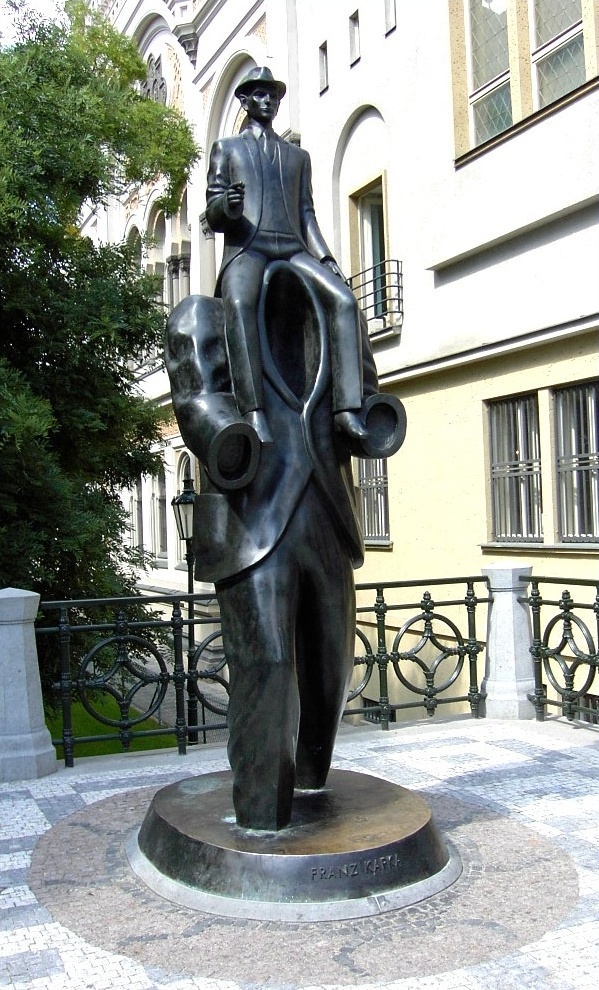 |
| Franz Kafka by Jaroslav Rona Courtesy of Henryart |
3. "Man Attacked by Babies" Vigeland Sculpture Park
This sculpture in Oslo is a bit alarming, especially without back story. It appears to be a man literally kicking a baby and perhaps having a few more tossed on him from above. Oh, the man is also quite naked. So, he's a jerk, right? Not really. If you look closer, you will see that the babies are horrifically evil in a subtle kind of way. The statue depicts a man being attacked by imps in the guise of babies. That explains why he's trying to kick a field goal with one of them.
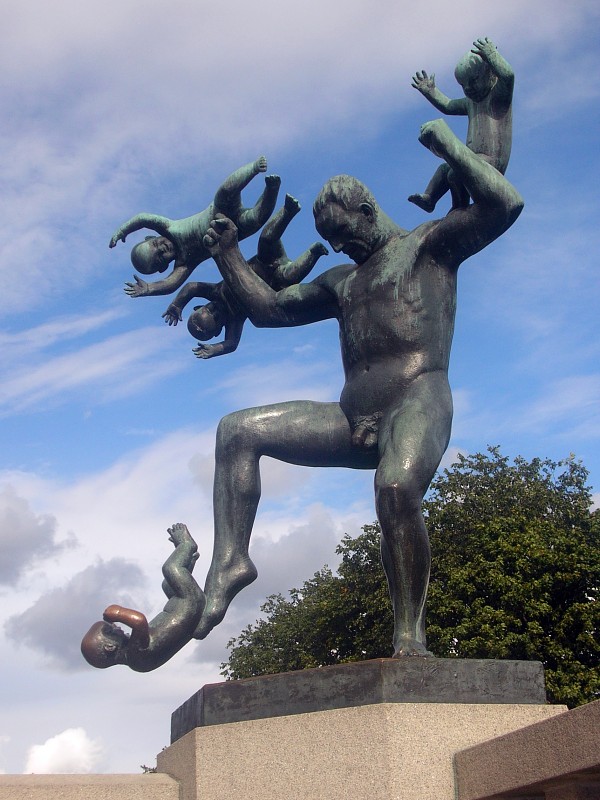 |
| "Man Attacked by Babies" by Gustav Vigeland Courtesy of Grzegorz Wysocki |
4. Babies of Prague
Here we are back in Prague, a place that clearly allows alarming art to litter the streets. Guess what else is back? David Cerna and his seriously creepy aesthetic. The babies are large sculptures found in several places. I'm not quite sure just how many there are, but I do know the best way to see them is from the base of the Zizkov Television Tower. There are many crawling up it so it looks like it is being attacked by mutant children. The best part is their faces or I should say their lack of faces. The heads are fronted by what looks like a rectangular butthole.
 |
| Baby by David Cerny Courtesy of David Cerny |
5. Bukchon Museum Bench in Seoul
Bukchon Museum in Seoul is a quaint little museum in Seoul, Korea. Just outside of its glass front is a bench that makes for a great photo opportunity. It may be more fun that bizarre, but it certainly is strange. On either end is a large head with exaggerated features and straight, even teeth. Inside of these teeth is clenched the wood of the bench. The effect is two men's heads coming up out of the sidewalk and trying to eat either side of a cracker a la Lady and the Tramp.
(I could not find a public domain or shared photo of this piece. Just Google "Bukchon Museum Bench. Sorry for the inconvenience.)
6. The Child Eater of Bern
Okay, the German name for this sculpture is Kindlifresserbrunnen, but I'm not typing that more than once, so Child Eater of Bern it is. This Swiss sculpture was made by Hans Gieng in the 16th century CE. It features a very colorful ogre or man with a sack full of babies in one arm. The other arm is engaged in shoving one of the children in the ogre's mouth. The ogre is part of a larger statue. There is some mystery as to what it means, as there appears to be no record of the inspiration behind the design.
 |
| "Kindlifresserbrunnen" by Hans Gieng Courtesy of Arno Konings |
Instead of wading through the strange statues in this park, I'm just going to invite you to Google it and see what pops up. I think you will be hard pressed to find a single statue that isn't bizarre inside of the park.
(None of the photos I could find of this park in the public domain were cool enough. Again, just use Google. I hate to make you do it, but the alternative is worse.)
Bizarre Plants: Gympie, Gympie
 |
| Gympie, Gympie courtesy of Petr Dlouhý |
Along the entire roughly 3 to 9 foot tall plant are stinging hairs that can embed themselves in your skin. These stingers emit an extremely painful neurotoxin. The sting causes a cluster of red dots that eventually spread until they grow together. The intense pain is known to be strong enough to put people and animals out of their minds. It can go on for months. What is worse, allergic reactions to the plant may get worse with repeated exposure, as with researcher Marine Hurley.
Stings from the gympie gympie can allegedly kill humans and large mammals. That means victims should get the stinging hairs out as soon as possible and seek palliative treatment. You can remove the stingers with a hair removal strip. Most people don't have those lying around while hiking, but being aware of your surroundings and being prepared goes a long way, so start if you know these plants are nearby.
The Bizarre Letter of the Axeman of New Orleans
Sometimes, even serial killers take bizarre to another level. Sure, they are already inherently weird, since most of us just do not go around axing people, but there are those who go above and beyond the standard serial killer oddity. One of these killers, who is presumably a man, but was never caught, is the so-called "Axeman of New Orleans." As mentioned above, him killing people is not exactly strange in the world of serial killers, so we are going to skip that and get straight to a letter purportedly written by him and that gives citizens an odd get out of murder free card.
(If you want to read a detailed account of the Axeman of New Orleans' crimes, there is a thorough one here.)
In a letter dated March 13, 1919, the Axeman of New Orleans or someone purporting to be him wrote a tremendously creepy self-assessment and threat. The self-assessment was predictably grandiose. He was no man. He was Satan's homie, blah, blah, blah. On top of this, he professes his love of jazz music. Okay, so he likes jazz music. Not that strange. He then says he will "visit" the city "next Tuesday night." The date was March 19. Anyone playing jazz music would be spared. Seriously? What kind of serial killer is this?
The Axeman never did kill anyone that day. It was not because the whole city was playing jazz. Many were, but many purposely did not. Maybe he just wimped out. He did kind of set himself up for failure there. Maybe the letter wasn't really written by him. Whatever the case, it was a strange enough story to make it into "American Horror Story: Coven," in case you are interested in seeing an entertaining account of the time.
By the way, speaking of weird, I now have the Beatles' "Taxman" stuck in my head as "Axeman." You're welcome.
(If you want to read a detailed account of the Axeman of New Orleans' crimes, there is a thorough one here.)
In a letter dated March 13, 1919, the Axeman of New Orleans or someone purporting to be him wrote a tremendously creepy self-assessment and threat. The self-assessment was predictably grandiose. He was no man. He was Satan's homie, blah, blah, blah. On top of this, he professes his love of jazz music. Okay, so he likes jazz music. Not that strange. He then says he will "visit" the city "next Tuesday night." The date was March 19. Anyone playing jazz music would be spared. Seriously? What kind of serial killer is this?
The Axeman never did kill anyone that day. It was not because the whole city was playing jazz. Many were, but many purposely did not. Maybe he just wimped out. He did kind of set himself up for failure there. Maybe the letter wasn't really written by him. Whatever the case, it was a strange enough story to make it into "American Horror Story: Coven," in case you are interested in seeing an entertaining account of the time.
By the way, speaking of weird, I now have the Beatles' "Taxman" stuck in my head as "Axeman." You're welcome.
A Crappy Christmas Tradition: The Caganer
 |
| Traditional Caganer |
Before we jump into the how, where and exactly what of this Christmas tradition, let's just translate the name for you know whats and giggles. Caganers stands for "the crapper" or a less decorous term, if you can imagine. "The Crapper" is a character in the traditional Catalan nativity scene," which involves the entirety of Bethlehem. For at least the past few hundred years, a crapping peasant can be found among these nativities. Yes, we are talking a figurine with its pants around its knees and poop behind him. No one is quite sure why or how this tradition came about, but there you have it.
Because the nativity scenes in Catalan tradition involve so much more than just the manger, caganers are not the only figures added that Westerners would not typically see. Nonetheless, this little guy remains the most controversial or funny, depending on your view of the thing. Remember, you may have to look for him if you come across a Catalan nativity, as some families like to hide "the crapper" for the kids to find.
The Roden Crater Observatory
We may have not delved into this area of things that are bizarre, but it is possible for something to be so extraordinary as to be bizarre and also be beautiful, amazing and brilliant. Such is the case with the subject of this blog post. One man is so dedicated to that which has inspired him that he has gone ahead and purchased an entire cinder cone crater in order to make his vision come true. That vision - an artistic naked eye observatory in the middle of the San Francisco Volcano Field at 5,400 feet. It is in the Roden Crater, to be precise.
The crater itself is something to behold. If you get the chance, find a shot of it from the sky. The red and black of the cinder cone are rather pretty in the context. Artist James Turrell stands at this location and wants people to have "a sense of standing on the planet" by integrating a structure at the location with the sky. If this sounds a lot like ancient structures like Stonehenge, that is because Turrell used ancient observatories and other monumental construction as inspiration for his project.
The Roden Crater naked eye observatory is not complete. Turrell, his investors and his team have put a lot of work into preparing the site. Nonetheless, there is still a lot to do and Turrell purchased the cinder cone in 1977! If time and effort are any indication of result, visiting this observatory is going to be a must-do. If you want to see visual representations and photos or donate to the project, go to http://rodencrater.com/about.
The crater itself is something to behold. If you get the chance, find a shot of it from the sky. The red and black of the cinder cone are rather pretty in the context. Artist James Turrell stands at this location and wants people to have "a sense of standing on the planet" by integrating a structure at the location with the sky. If this sounds a lot like ancient structures like Stonehenge, that is because Turrell used ancient observatories and other monumental construction as inspiration for his project.
The Roden Crater naked eye observatory is not complete. Turrell, his investors and his team have put a lot of work into preparing the site. Nonetheless, there is still a lot to do and Turrell purchased the cinder cone in 1977! If time and effort are any indication of result, visiting this observatory is going to be a must-do. If you want to see visual representations and photos or donate to the project, go to http://rodencrater.com/about.
The Disappearances of the Corte-Real Brothers
_oferta_do_Estado_Portugu%C3%AAs..jpg) |
| Statue of Gaspar Corte-Real in Newfoundland |
In 1501, Gaspar Corte-Real went on his second mission to try to find the Northwest Passage. The first time he made it as far as possibly Greenland. This second time around, he made it to what we now think was Canada and then sent two of the three Portuguese sailing ships that went with him on this mission home. One of them carried his brother Miguel Corte-Real. The ship with Gaspar and the man himself were never seen again. The two that were sent home made it there safely.
In an attempt to find his brother, Miguel Corte-Real headed to the Northwest Passage in 1502. He too brought three caravels with him. He too sent two of the three sailing ships home. He too was never seen again. Like his brother's expedition, the two ships that went home made it there just fine. In spite of receding ice and much safer travels in the north these days, no evidence of either of their ships has been found.
Subscribe to:
Posts (Atom)