Bizarre WWII Weapon: Balloon Bombs

Oregon memorial to the lives  lost due to the balloon bombs
Oregon memorial to the lives
lost due to the balloon bombs
Courtesy of Gary Halvorson
During World War II, Japan and the United States were scrambling to outdo each other on the battlefields, in the air and with surprise attacks on often mostly civilian targets. It started with the Japanese attack on Pearl Harbor, which in turn triggered the Doolittle raids against Japan. Most people believe that the next event that involved a surprise attack was the bombings of Hiroshima and Nagasaki. However, before that occurred, the Japanese bombed American soil over a period of five months.

After the Doolittle raids, the Japanese were looking for a way to retaliate against the United States. They eventually came up with a plan to build thousands of balloons and attach 15-kilogram bombs to them. The balloons and the bombs would then be sent across the Pacific to the United States. The project took nearly two years to complete and required the closing of schools so that children could help in the construction of the balloons, of which there were 9,000 total. The Japanese called these devices Fu-Go weapons.

The first bomb balloons were sent on November 3, 1944. They were specially designed to stay between 30,000 and 38,000 feet in altitude so that they would remain in the jet stream for long enough to reach the United States. They were not equipped with navigational systems and they weren’t capable of guiding themselves. The idea was that they could just ride the jet stream over the Pacific Ocean and to the United States. Nearly one thousand of the balloons actually reached their destination or Canada. What happened to the other eight thousand is uncertain, though it is thought that they simply fell out of the air and into the Pacific.

The bombs that did land in the states did relatively little damage. However, some of the balloons were equipped with incendiary bombs that did cause some forest fires in the northwest United States. The United States government found it wise to cover up the success of the bombing in regards to the media. If the information had reached the Japanese, they certainly would have continued the bombing or possibly modified the balloon bombs to make them more deadly. As it was, they continued sending the balloons until April of 1945 and five people died as a result. The victims were killed when they were picnicking and saw one of the balloons caught in a tree. They attempted to pull the balloon out and the bomb exploded, killing four children and their mother.

There is the possibility that there are live balloon bombs in the United States that haven’t been detected, as of yet. There are still eight thousand balloon bombs that are unaccounted for. Even if it is likely that they fell into the Pacific, there is still a strong chance that some of them made it and are waiting in remote locations.

Sources

Japanese Balloon Bombs, retrieved 10/02/09, japaneseballoonbombs.com


Balloon Bombs: Japan’s answer to Doolittle, retrieved 10/02/09, nationalmuseum.af.mil/factsheet.asp?id=1492

The Anthrax Letters

Letter Envelope
On September 11, 2001, foreign terrorists attacked the United States. Citizens of the United States were shocked, scared and grieving. It was a time of paranoia and distrust. People wondered when and if the country would be attacked again. Then, a matter of days later, something happened that caused nearly everyone to believe that the U.S. was still under attack. A number of letters containing spores of the bacteria that causes anthrax were sent to public figures. People who had been exposed to these letters, or letters that had come into contact with the anthrax letters, began falling ill.

Anthrax is a disease that is caused by the bacteria Bacillus anthracis. It typically affects herbivorous mammals, but can infect any mammal, as far as we can tell, including humans. Most human anthrax infections are caused by contact with infected animals or infected animal byproducts. There are three ways to contract the disease, through open skin, breathing in spores or eating the bacteria. It is not contagious, meaning it cannot be spread from one infected human to another. The bacterium is tasteless, odorless and the amount needed to kill a person is invisible to the naked eye.

Anthrax that is contracted through the skin, or cutaneous anthrax, causes necrosis. It starts as a small bump that escalates into a painless ulcer. This form of anthrax is highly treatable. Only one percent of treated cases of cutaneous anthrax will cause death. The mortality rate is 20 percent for untreated cases.

Anthrax that is contracted through the digestive system can cause a painful death. The symptoms are nausea, vomiting and loss of appetite. Later symptoms include bloody vomit and diarrhea. Twenty-five to fifty percent of people who contract anthrax in this manner will die.

Anthrax that is contracted through the lungs is the deadliest form of the disease. Symptoms start like the common cold and progress to severe difficulty breathing. Eventually it becomes so bad that victims have described the sensation as having your head held under water. Shock is very common in this form of anthrax. Roughly 75 percent of people who contract anthrax through their lungs will die. The Anthrax letters of 2001 caused five deaths. All of them occurred in individuals who had inhaled the bacteria.

According to the F.B.I., there were four letters (there are claims of more, however). The first two were sent on September 18, 2001. Their intended recipients were Tom Brokaw of NBC and the New York Post. Two more were sent October 9, 2001. The intended recipients of these letters were Senators Tom Daschle and Patrick Leahy. All of the letters were mailed from a box in Newark, New Jersey. According to the CDC, 23 people contracted anthrax as a result of these letters; one of them was a baby. Obviously, the person or group was sending these letters did not care who got hurt.

Through handwriting analysis, the F.B.I. was able to conclude that the same person wrote each of the letters. Of course, this did not rule out the possibility that a group planned the attack. The popular (and logical) thinking, initially, was that a foreign terrorist group was responsible for the attack. Authorities knew that they had to uncover the person responsible and fast. Terrorists who are capable of using biological weapons and are not afraid to use them are a scary prospect. However, authorities did not uncover a foreign terrorist group. When it was found that the anthrax came from an American source, the F.B.I. turned their attention to possible domestic terrorists.

The first public "person of interest" in the anthrax letters case was Doctor Steven Hatfill. Hatfill was an Army doctor. He was closely scrutinized by the F.B.I. for quite some time. He was eventually found innocent of any wrongdoing. However, he had been so closely watched that he felt it had damaged his career. He sued the government for invasion of privacy and won.

The next noteworthy "person of interest" in the anthrax letters case was an unassuming Army biodefense expert, Doctor Bruce Ivins. The F.B.I. had concluded that the anthrax causing bacteria had come from his laboratory (experts have since claimed that the F.B.I.'s evidence for this was not conclusive). They subjected Bruce to the same scrutiny that they subjected Steven to. However, they found many things that led them to believe that Bruce was their guy. Bruce had a number of photos of blindfolded women in his computer (circumstantial); later in the investigation, they found correspondence of Bruce's in which he claimed to have multiple personalities (circumstantial); the F.B.I. discovered that Bruce was obsessive about women (circumstantial) and they also listened in on a conversation in which Bruce said that he couldn't remember having mailed any anthrax letters and that he thought (hoped) he wasn't capable of such a thing (decidedly not a confession). Dr. Bruce Ivins committed suicide by ingesting an overdose of Tylenol in 2008. He never confessed to the crimes, nor has direct evidence been found linking him to the anthrax letters.

In February of 2010, the F.B.I. officially closed their investigation into the anthrax letters of 2001. They concluded that Dr. Bruce Ivins was responsible for the letters and that he acted alone. Many people believe that the F.B.I. closed the case prematurely and/or that they based their investigation on preconceived notions. Lawrence Sellin Ph.D., and others, believes that, while it could have been Ivins, the case has yet to be thoroughly investigated. Furthermore, it is the belief of some that Ivins' mental issues (apart from his obsession with women, which hardly makes him a murderer), including his suicide, were a direct result of the investigation.

Read more from the F.B.I.'s investigation here.

Sources

Council on Foreign Relations, The Anthrax Letters, retrieved 5/1/10, cfr.org/publication/9555/#p1

Shane, Scott, F.B.I., Laying Out Evidence, Closes Anthrax Case, retrieved 5/1/10, nytimes.com/2010/02/20/us/20anthrax.html


Questions and Answers About Anthrax, retrieved 5/1/10, bt.cdc.gov/agent/anthrax/faq

The Bizarre Life and Death of Anneliese Michel: A Woman Possessed

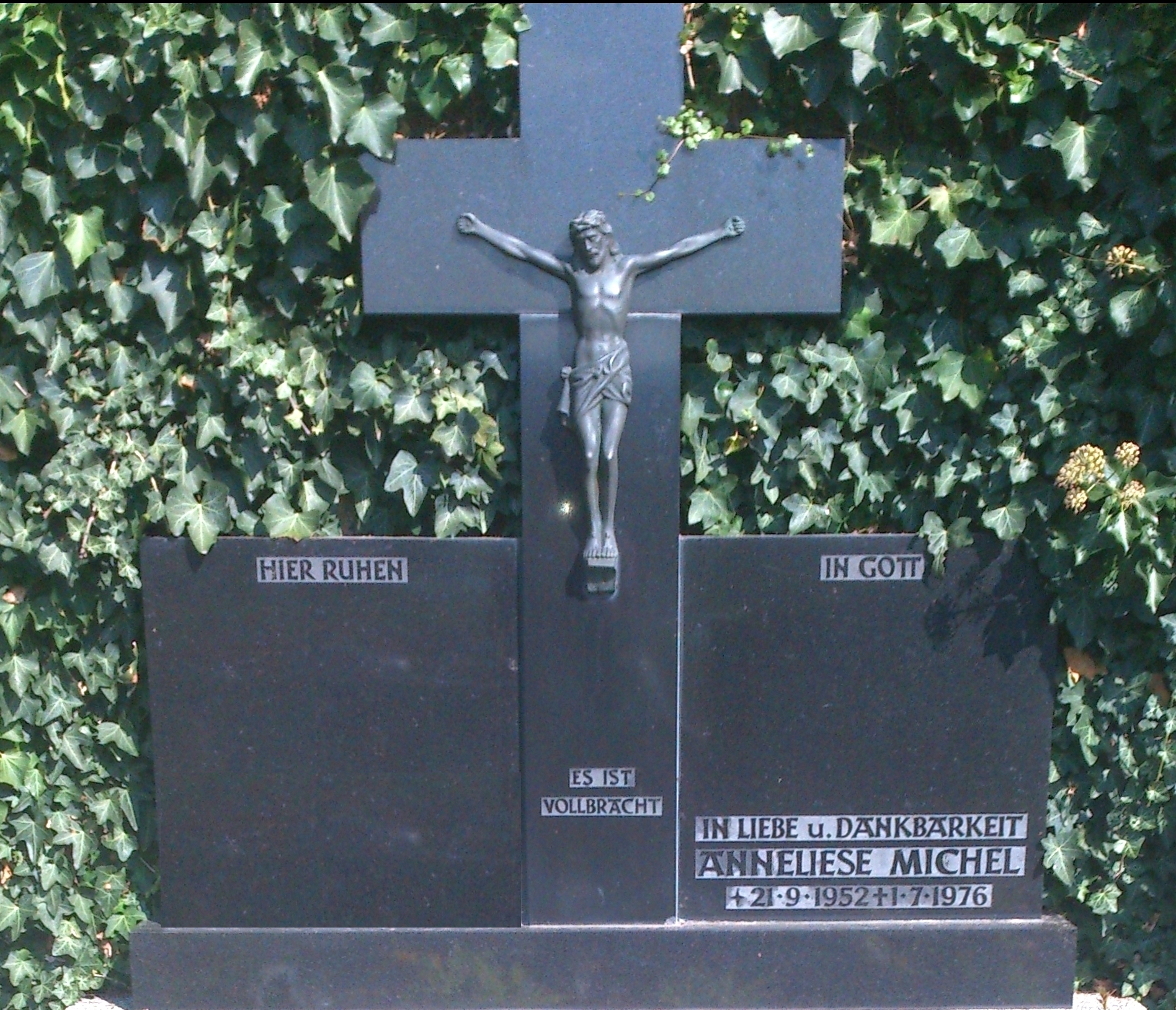
The gravestone of Anneliese Michel
Anneliese Michel was born in Germany on September 21, 1952. She grew up in an arguably extremly Catholic family. Pictures of her taken in her childhood show a vibrant, pretty girl on her way to becoming a gorgeous, healthy woman. She had shining black hair, an open, honest face and a stunning smile. By the time she was 23-years-old, she was emaciated, heavily bruised, scarred and deranged. She was allegedly taken over by demons and fought for nearly eight years before finally losing her battle with evil. Later, her death was labeled negligent homicide, but was there anything anyone could have done for Anneliese Michel? Were those who were with Anneliese really fighting Satan or did her caretakers fail to treat a serious mental illness?

Four years before Anneliese was born, her mother, Anna Michel gave birth to an illegitimate daughter. This was a source of shame for the Catholic family. After she married and gave birth to Anneliese, she apparently harbored feelings of guilt about her first daughter. Unfortunately, Anneliese's older sister died at the age of eight, but Anneliese reportedly felt like she needed to repent for her mother's sin. It is said she spent much of her time doing penance for her mother, sinful youth and bad priests.

Anneliese's symptoms of possession or mental illness began in 1968. Anneliese was a 16-year-old high school student. The symptoms were convulsions and they were eventually diagnosed as epilepsy by a neurologist. Michel took medicine for her condition and continued her life to the best of her ability. She finished high school and went on to college, where she studied to become a teacher. Apparently, the medicine was not helping her much. Her problems only got worse.

Over time, Anneliese complained of seeing disturbing visions while saying her prayers. Later, evil voices giving her commands followed. Finally, Anneliese began showing an aversion to religious iconography. An older woman, a friend of the Michel family, noticed this while on a pilgrimage with Anneliese. She said that Anneliese smelled "hellishly bad" and took her to see some priests. Many of them said Anneliese needed a doctor. However, one said Anneliese needed an exorcism and that exorcism was eventually granted.

In 1975, Anneliese Michel and her parents stopped seeking medical advice and gave over Anneliese's fate to the Roman exorcism ritual. Anneliese, the priests and her parents truly believed she was possessed. Anneliese Michel herself said that Judas, Nero, Hitler, Cain, Lucifer and others were inside of her. Over the next ten months, Father Arnold Renz and Pastor Ernst Alt performed 67 exorcisms on the tormented girl. It is important to note that every action taken during these rituals was condoned by Anneliese. However, most would say her ailment was mental and that she could not have understood what was really happening.

Sometimes, the seriously ill Anneliese would perform hundreds of genuflections during these rituals. It is rumored that her parents held her up for them when she got too weak to do it herself. It is not hard to imagine this being necessary, given that Anneliese stopped eating altogether for some time before she died. She believed it would lessen the evil's control over her. There are claims that Anneliese spoke several different languages (or the demons and evil souls that possessed her did) during the exorcisms. The author of this article cannot verify such claims, as she does not speak the languages Anneliese supposedly spoke in the tapes.

It is certain that medicine was not saving Anneliese Michel from whatever tormented her, but there is no questioning that things got worse for her when she gave herself over to exorcism. In all likelihood, she needed a different kind of medical attention. She allegedly urinated and defecated on the floor frequently, also licking up her own urine. She ate insects, growled at religious icons and sat under her kitchen table barking for two days. Surely, her family was afraid of her, but a medical professional probably would not have left her under the table for two days or let her starve to death, which is eventually what she did.

Anneliese Michel died of dehydration and malnutrition on July 1, 1976. The 23-year-old woman weighed 68 pounds at the time of her death. Josef Michel (her father), Anna Michel and the two exorcists were eventually charged with negligent homicide. During the trial, evidence of the possession worked both for and against the defense. Forty-two of the exorcisms were audio-recorded and there were various pictures of a seriously ill-looking, bruised and sore-covered Anneliese. Anneliese is horrifying in these tapes which might have helped the defense, but is certainly not conclusive. If nothing else, the tapes made it clear that Anneliese was seriously ill and no one was making her eat. It is certain that possessed or not, Anneliese should have been cared for better.

There is no way to prove or disprove supernatural occurrences, such as possession. That makes it difficult to know what really happened to Ms. Michel. However, it is possible to prove that there is some evidence that epileptics are at an increased risk of displaying symptoms of schizophrenia and it is has been posited that Michel suffered from dissociative personality disorder and schizophrenia. That, combined with her religious background, could easily account for the events leading to her death.

Tape of Exorcisms of Anneliese Warning: This is very disturbing

Sources

Questioning the Story, retrieved 4/8/11, chasingthefrog.com/reelfaces/emilyrose.php

Slater, Eliot & Beard A.W., The Schizophrenia-like Psychology of Epilepsy, retrieved 4/8/11, bjp.rcpsych.org

The Ivanov Experiments or Humanzee

Hybrids, when not in the annals of science fiction, are not very intimidating things. We get often-infertile animals like the mule and wholphin from two similar species producing viable offspring. However, there is an interesting realm where few have dared to tread -- human hybridization. This is very intimidating for many. In fact, some are outright enraged at the idea. No matter where you stand on the matter, the truth is that a human and chimpanzee has been hypothesized and the science adds up quite enough that it is not unreasonable to assume it could happen.

In the first half of the 20th century, a Russian scientist named Ilya Ivonavich Ivanov was a successful zoologist. He wasn't just sitting around his lab thinking up insane ways to freak people out. He developed a method of artificial insemination for livestock. His main focuses were to create sturdy hybrids and save endangered species. We do not remember him for that. We remember him for trying to make a human/chimpanzee hybrid.

It seems the first known mention of Ivanov's interest in this "field" came in 1910, when he spoke about it. Over the next 20 years, he worked on the idea off and on. He clearly was never successful, but he did not have a whole lot of support. It definitely couldn't be said that an exhaustive effort was made and it just isn't possible. His efforts were stopped in 1930 when he was arrested based on what seems likes unrelated events during a time of difficult for scientists in Soviet Russia.

The Bizarre Murder of Tim McLean

Some crimes even stand out among other, similar crimes. It is not usually because of their depravity. It is rather obvious that few things are left to do to other human beings that have not been done before. What usually makes them stand out is some factor outside of the crime itself. In the case of the murder of Tim McLean, it was the brazen boldness of the act combined with its extreme violence that make it bizarre in the annals of crime. The perpetrator is certainly not the only man to commit a similar act in a similarly public way, but the cases are rather few.

Before we get into details, know that this is a horribly sad and gory tale. It happened on a moving Greyhound bus near Portage la Prairie, Manitoba. Mr. McLean was a 22-year-old carnival worker who was taking that bus home to Winnipeg at the end of a job. He sat very near the back of the bus, only one row up from the bathroom. He had boarded the bus at about 12:01 the afternoon of July 30, 2008.

About 7 hours after McLean got on the bus, it was boarded by another man, a stranger to the first. His name is Vince Weiguang Li. Li sat near the front of the bus initially. However, he eventually made his way toward the back, sparking the suspicion of no one with his calm and composed movements. He chose a seat next to the extraordinarily unfortunate Tim McLean, who proceeded to fall asleep with his headphones on. He awakened only briefly to a nightmare.

While McLean was asleep, Li took out a knife one witness would describe as a "Rambo knife." He then stabbed McLean in the neck and chest repeatedly. McLean woke and tried to fight off his attacker to no avail. By this point, other people on the bus were aware of what was happening. Either one had screamed or McLean had, alerting one witness to the event. The bus driver stopped and the terrified passengers disembarked. A few men and the bus driver tried to get back on to help McLean, but they were warded off by Li and his knife.

While the other passengers stood outside, some ill, some trying desperately to come up with a plan, Li removed his victim's head and displayed it, calmly they said, to the people outside. He then returned to the corpse and began cutting at it. Witnesses say he ate some of the pieces. Given that McLean's eyes and part of his heart were never recovered, the statement holds up. He also paced the bus, tried to drive it away and tried to leave it. He was unsuccessful thanks to the efforts of the driver, some of the passengers and a good Samaritan truck driver.

The police eventually arrived and relieved the traumatized bystanders. There was something of a stand off and then police managed to taze Li as he smashed a window and tried to the leave the bus. Contrarily, a police officer had heard him say, "I have to stay on the bus forever" a bit earlier. Once in custody, the police found McLean's nose, ears and tongue in the murderer's pockets. Li was found insane by the court and remains in a mental health facility where he continues to struggle with the idea that he cannibalized a man, according to staff.

Bizarre Hoax: 54 Berners Street

Sometimes, there is some fun to be had in analyzing the most bizarre things we can find in history, the present and nature. Among the best lighthearted bizarreness are hoaxes. Sure, they are not so much fun for the victim(s), but, in my opinion, it sure beats writing about murderers and poisonous plants. I lied, I love writing about poisonous plants, but I'm getting off topic. I'm here to tell you about the Berners Street Hoax and that is what I am going to do.

Back in 1810, gentlemen weren't exactly the stiff pains in the butt you may imagine them to have been. At least, Theodore Hook wasn't stiff. He was definitely a pain. He bet a friend, legend has it this friend was Samuel Beazley, that he could turn 54 Berners Street into the most famous home in London in a single week. He won the bet.

On November 27 or 26, depending on the source, the chaos began with a chimney sweep knocking on Mrs. Tottenham's door at 54 Berners Street at a very early hour. She hadn't ordered one, but that didn't stop this service provider and countless others from arriving that day. Before the day was over, people were delivering wedding cakes and pianos, offering condolences for a death that had not occurred and the mayor even arrived to have a meeting with the homeowner, but left when he realized that his summons was a lie. It was an easy assumption to make, given that the street was so crowded as to be blocked and even was officially blocked at one point.

It turns out, Hook had sent between 1,000 and 4,000 letters to the people and workers of London asking them to come to the house under a variety of pretenses. The sheer number of letters points to an accomplice, but exactly who helped him is not certain. In fact, police never even apprehended him in the case. He was suspected, but never arrested. You may say he would have deserved it. No doubt people lost money on the prank, but it is remembered more than 200 years later, so his prank had its merit.

Bizarre Statues Around the World

Before we even get started, I'll admit that there is a bunch of weirdest statue posts on the Internet. I definitely lose points for originality. However, there is none here and I'm catering this list to suit That is Bizarre! You will find that this list is a bit limited in at least one way. I'm not including sexually explicit statues. Most of them aren't really bizarre unless you're a prude. I'm only including ones that I found truly strange, even in context.

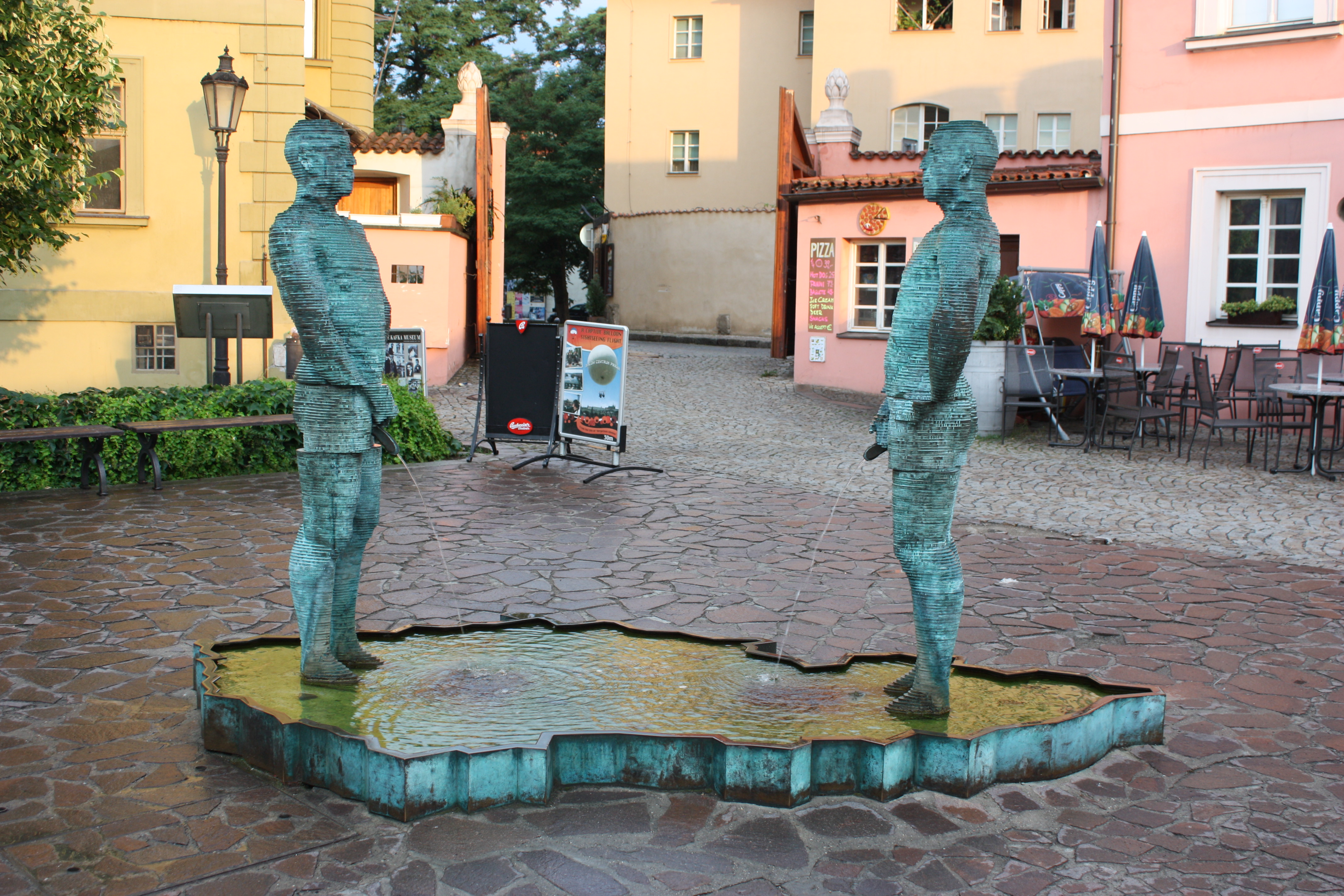
1. The Peeing Men in Prague

Okay, this one really isn't called "The Peeing Men in Prague." I'm not really sure what it is called, so I just described it. These men are placed outside of the Franz Kafka museum. This piece is by sculptor David Cerny, who I am relatively sure makes more than one appearance on this list. This certainly is not the first sculpture to use the way men urinate as inspiration for a fountain, but it is an interesting one. The, ahem, spigots on the sculpture will draw out shapes and will even write out texts sent to a specific number.

"P*ssing Men Statue" by David Cerna
                            Courtesy of Kenyh Cevaron


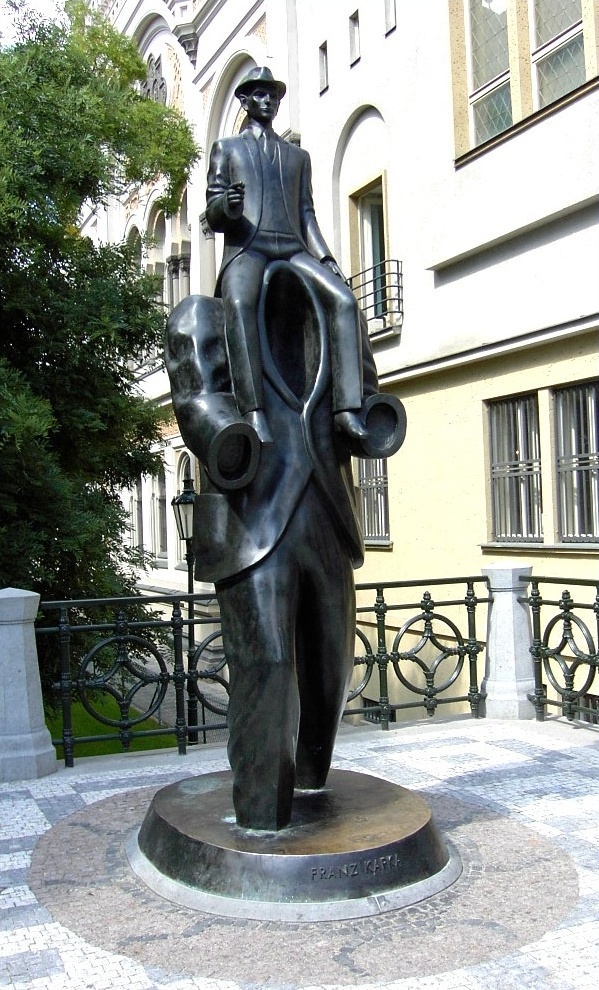
2. Franz Kafka Statue -- Prague

Well, it appears that Mr. Kafka inspires some very strange sculptures. The man was a master of bizarre stories, but it is not entirely certain what these strange works have to do with him, if anything. This particular sculpture by Jaroslav Rona. Sure, it is loosely based on one of Kafka's stories about a man riding on another man's shoulders, but this one features Kafka himself riding on the shoulders of what looks like a very large, empty suit.

Franz Kafka by Jaroslav Rona
Courtesy of Henryart

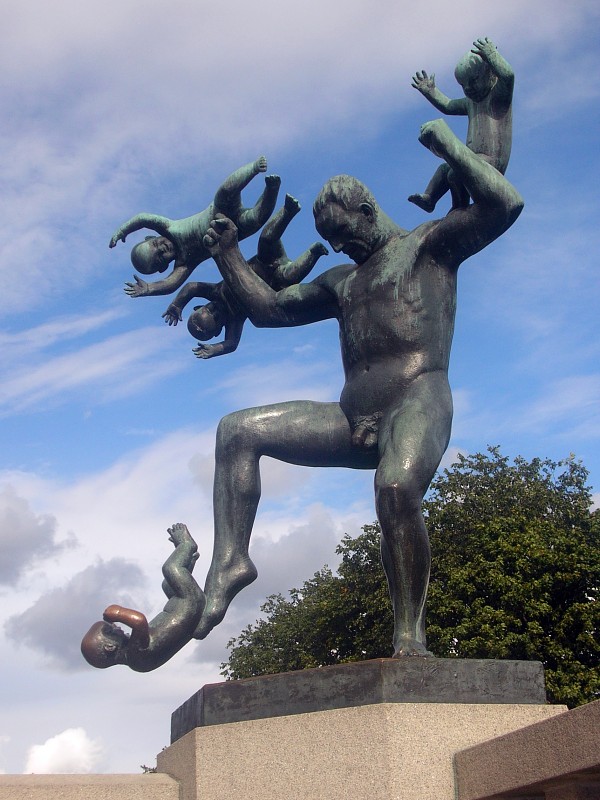
3. "Man Attacked by Babies" Vigeland Sculpture Park

This sculpture in Oslo is a bit alarming, especially without back story. It appears to be a man literally kicking a baby and perhaps having a few more tossed on him from above. Oh, the man is also quite naked. So, he's a jerk, right? Not really. If you look closer, you will see that the babies are horrifically evil in a subtle kind of way. The statue depicts a man being attacked by imps in the guise of babies. That explains why he's trying to kick a field goal with one of them.

"Man Attacked by Babies" by Gustav Vigeland
Courtesy of Grzegorz Wysocki


4. Babies of Prague

Here we are back in Prague, a place that clearly allows alarming art to litter the streets. Guess what else is back? David Cerna and his seriously creepy aesthetic. The babies are large sculptures found in several places. I'm not quite sure just how many there are, but I do know the best way to see them is from the base of the Zizkov Television Tower. There are many crawling up it so it looks like it is being attacked by mutant children. The best part is their faces or I should say their lack of faces. The heads are fronted by what looks like a rectangular butthole.

Baby by David Cerny
Courtesy of David Cerny

5. Bukchon Museum Bench in Seoul

Bukchon Museum in Seoul is a quaint little museum in Seoul, Korea. Just outside of its glass front is a bench that makes for a great photo opportunity. It may be more fun that bizarre, but it certainly is strange. On either end is a large head with exaggerated features and straight, even teeth. Inside of these teeth is clenched the wood of the bench. The effect is two men's heads coming up out of the sidewalk and trying to eat either side of a cracker a la Lady and the Tramp.

(I could not find a public domain or shared photo of this piece. Just Google "Bukchon Museum Bench. Sorry for the inconvenience.)

6. The Child Eater of Bern

Okay, the German name for this sculpture is Kindlifresserbrunnen, but I'm not typing that more than once, so Child Eater of Bern it is. This Swiss sculpture was made by Hans Gieng in the 16th century CE. It features a very colorful ogre or man with a sack full of babies in one arm. The other arm is engaged in shoving one of the children in the ogre's mouth. The ogre is part of a larger statue. There is some mystery as to what it means, as there appears to be no record of the inspiration behind the design.

"Kindlifresserbrunnen" by Hans Gieng
Courtesy of Arno Konings
7. Victoria's Way Indian Sculpture Park in County Wicklow, Ireland

Instead of wading through the strange statues in this park, I'm just going to invite you to Google it and see what pops up. I think you will be hard pressed to find a single statue that isn't bizarre inside of the park.

(None of the photos I could find of this park in the public domain were cool enough. Again, just use Google. I hate to make you do it, but the alternative is worse.)