Bizarre Weather: Ball Lightning


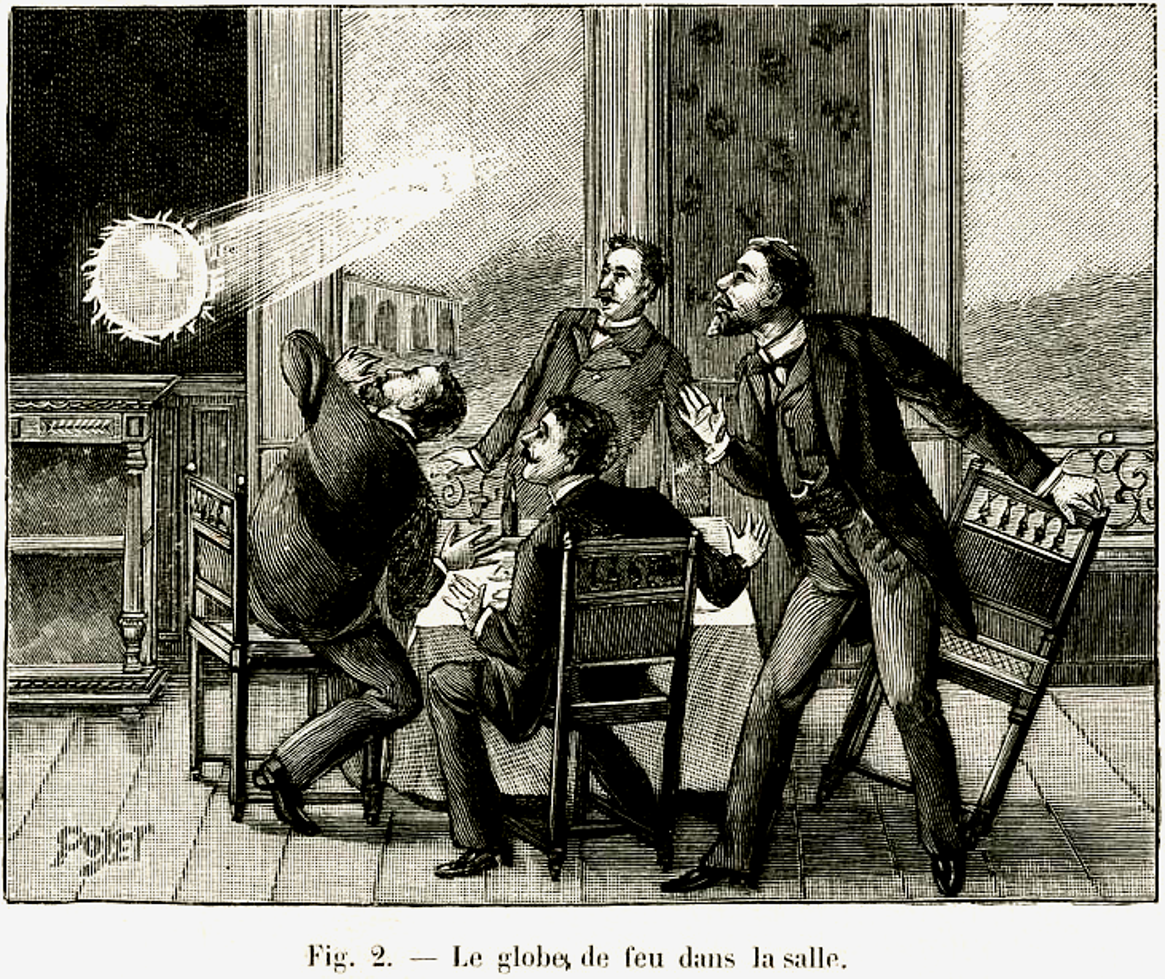
An engraving from the 1800s showing ball lightning.

Ball lightning is an unexplained weather phenomenon that is seen all over the world. Some people do not believe it exists. However, according to the National Geographic article Ball Lightning: A Shocking Scientific Mystery, as many as 1 person in every 30 thinks they have witnessed this phenomenon. Conservative estimates put those numbers at between 1 and 150; still nothing to sneeze at.

Ball lightning is what it sounds like, a ball of what appears to be electricity. It appears to occur most often, or always, near the ground, where it bounces around like a drunken version of Tinkerbell. According to some sources, it is powerful enough to melt glass and thin metal, such as window screens. It does not have as much of a record of being fatally dangerous as "normal" lightning, but it may be potentially deadly.

Over the course of written history, roughly 10,000 eyewitness accounts of ball lightning have been written. The stories are similar enough to suggest that these people are seeing the same thing. It seems unlikely that something that does not exist would have so many witnesses, pictures and reliable accounts. (Be careful if you search for pictures of ball lightning. Many online photos of "ball lightning" are not ball lightning at all. It does not strike as "normal" lightning does.)

Scientists have no idea what ball lightning is or how it happens. Because of this, it is nearly impossible to study. It lasts for roughly 10 seconds and not knowing how it is made makes it impossible to reproduce. Unless ball lightning starts appearing around scientists a lot more than it has been or scientists are able to replicate it, it is likely that we will not find out what this oddball lightning is for a long time to come. All theories are mere conjecture based on what we know about the world and electricity.

Bizarre Weather (Kind of): Fire Whirls

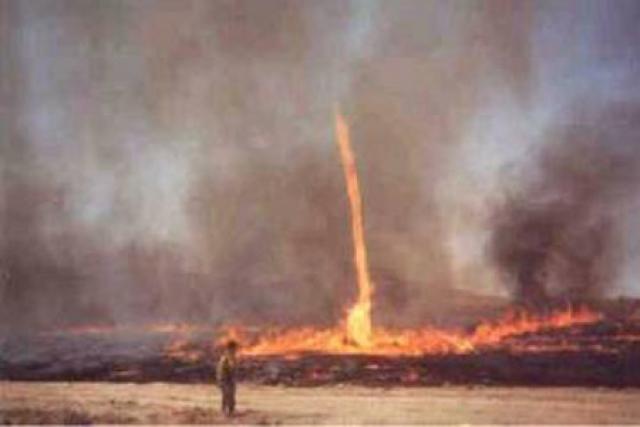
Fire tornadoes, fire whirls, fire devils, creepy spiral fire finger shooting up from the ground, whatever you call it, a fire whirl is a freaky phenomenon. They are upside down tornadoes that whip fire around instead of air. However, they are caused by air currents, but the obviously necessary ingredient is fire. These little devils can be more than 3,000 feet tall, spin at about 100 miles per hour and last for up to 20 minutes. Don't worry, though. That is only the worst-case scenario and you have to be caught in a heck of a wildfire to experience something like that.

Just to convince you to stay away from large fires, as if you needed convincing:
Courtesy of the U.S. Government

Courtesy of the U.S. Government


Bizarre Weather: Megacryometeors

When it comes to bizarre weather, megacryometeors are as bizarre as it gets. Sure, raining animals and invisible tornadoes are bizarre, but we have an idea what causes them and we typically have an idea that it is raining, even if it is raining something odd. Megacryometeors are impossible to predict, appear for no apparent reason out of clear skies, are capable of injuring people and their origins are completely unknown.

The best possible description of a megacryometeor is a huge chunk of hail appearing out of a clear blue sky. They have been known to cause property damage and small impact craters in the ground. These icy meteors can weigh between one and more than one hundred pounds. They are not meteors in the sense that they come from space -- as far as we know -- there is just no better name for them because they do not seem to originate from clouds and neither do meteors.

There are several theories out there that provide potential explanations for megacryometeors. One is a little gross, if you ever happen to be hit by a megacryometeor, but no worries, it has been proven wrong. For a long time, people thought that these ice balls might actually be waste from airplane toilets. Testing of megacryometeors shows that there is no evidence of human waste or toilet sanitation chemicals in them.

Another theory is that megacryometeors are ice chunks that forms on aircraft and then drop to the ground. The problem with this is that researcher and planetary geologist Jesus Martinez-Frias studied a bout of megacryometeors in Spain and found instances where planes were not known to be overhead at the time of the incident. There are also reports of megacryometeors from before there were aircraft.

Megacryometeors may also be simply forming high up in the atmosphere. There simply is no way to prove or disprove that, as there have only been roughly 50 reports of megacryometeors in the past 11 years. That slims down the risk of being hit with one -- thank goodness.

Bizarre Websites: Photo of the Day by Jamie Livingston

Bizarre websites? The internet has more of them than anything else. However, there are very few bizarre websites that are both bizarre and worth the time it takes to look at them. Photo of the Day at Hugh Crawford.com is just such a site. It combines simple creativity and motivation with life, friendship, love, music, illness and death all through the medium of Polaroid photographs taken by a man named Jamie Livingston.

The website spans 18 years of Jamie Livingston's life and there is one photograph for almost every single day of that time period. As you scan through the photos, you see such humorous things as a man dressed as an eyeball monster thing in a suit, such heartwarming things as friends and children playing music and such romantic things as a woman's face next to a ring she clearly just received. It also shows the wedding that ensues -- Jamie and this mystery woman. Most of the photos are of people, but there are also some snowmen, television sets, random urban landscapes, etc. It is really interesting to see.

While the website is certainly a testament to how the mundane can be interesting art, it is also a testament to a man's life. You see, Jamie Livingston died of brain cancer or a brain tumor in 1997. His friends run the site, which contains photos of his surgery scars, medication and his last days in the hospital. To be honest, the site is bizarre in the way that it shows something like this and in the way that Jamie kept up such a project for so long. However, it also shows that Jamie looked like a pretty cool guy to chill with. It's too bad he isn't still taking photos.

Bizarre Plants: Amorphophallus Titanum

Amorphophallus titanum
Credit: U.S. Government
Here at That is Bizarre, we have posted some interesting plants, from those with grenade like seed action to those that reek of carcasses. Amorphophallus titanum is another of those plants that smell awful, but that is not the only bizarre aspect of it. From its size to its name, it is quite the bizarre plant. In Sumatra, where it is endemic, it is known simply as "Bunga Bunkai." Nothing too bizarre there, but its Latin name mentioned above translates to "giant misshapen penis." It seems some people think this plant looks like a malformed sexual organ. It really does not, but we still love the name.

Amorphophallus titanum starts out as a root tuber that can weigh up to 200 pounds. From this tuber grows a plant that looks like a huge unshucked ear of corn. This part of the plant can grow up to several inches in a single day and some say can grow up to 10 feet, though it certainly can grow more than six. Once the plant is ready to bloom, it does so at night and it smells nasty. Some compare the stench to rotting meat. It also gets extraordinarily hot at this point and emits steam.

Once the spathe spreads (like a flower petal blooming), it can be up to four feet in diameter. The smell it omits is not to attract prey, but rather to pollinate. The male "flower" traps insects by closing its spathe around them. Next, it sticks pollen all over the hapless bugs. When it is done, it sets the bug free. Later, the bug will pollinate female Amorphophallus titanum. The male and female flowers of the plant open at different times, presumably to prevent same plant or male plant pollination. Once the female is fertilized, she produces red olive-sized fruits and dies within days.

The death of the female plant does not spell the end of Amorphophallus titanum. The root tuber grows a single leaf that eventually grows into an up to 20-foot tall plant that looks like a tree, but is not classified as such. At the top of the "tree," the resulting leaf blooms can be up to 16 feet around. It is not quite as eye catching as the green ear of corn that blooms into a burgundy and green flower, but it is life and it continues the cycle of the Amorphophallus titanum so it can produce stinky flowers again later.

Bizarre Culture: Japan's Inventive Ways of Committing Suicide

Seppeku Ritual
Sokushinbutsu, seppuku and kamikaze are inventive ways Japanese people have devised to kill themselves. Japan is notorious for that. It seems like an odd way to stand out among other nations, sure, but suicide just seems to be a major part of Japanese culture. Even today, after Sokushinbutsu, seppuku and kamikaze pilots have become history, the people of Japan have turned an eerie forest -- Aokigahara -- into suicide central. Why Japan seems to be a haven for the depressed and insane is anyone's guess. We know some forms of suicide are considered honorable there and we know the country has a long history of it, so it could be that history of patriotic and ritual suicide has paved the way for a softer stance on the action. Who knows? What we do know is that Japan sure has some bizarre suicides.

Sokushinbutsu is perhaps the most grotesque of the bizarre Japanese suicide stories on this list. That is because it involves the slow and painful death of Japanese monks who literally turn themselves into mummies whilst they are still among the living. First, they exist off a very scant diet for up to three years. They also exercise to lower their body mass. Next, came a phase of drinking non-lethal doses of arsenic. This goes on for yet another three years. At the end of the six years, the monks would then entomb themselves. They had a bell with them that they would ring once a day. When it stopped ringing, the monks were dead. After a period of a few years, their coffins would be opened by fellow monks. Those who did not rot had succeeded in mummifying themselves. At least twelve of these mummies still exist today. Thankfully, the practice has been illegal for more than 100 years.

Seppuku or "hara-kiri" is a samurai's suicide. If the samurai were in a position to be captured, he would kneel or sit and then stick a knife or short sword into the left hand side of his stomach. Then, he would drag the blade to the right, effectively disemboweling himself. This could also be done by disgraced samurai in lieu of execution. Another version of seppuku, done similarly, is oibara. Oibara is committed when a servant's master dies. Kamikaze is similar in that it is a warrior's death, but it took place among Japanese pilots in World War II. They would drive their planes into targets, both to prevent capture and to achieve glory.

Today, suicide is still all too common in Japan. Aokigahara forest is a popular place to do it. In fact, it is second only to the Golden Gate Bridge in popularity, when it comes to offing yourself. According to some sources, an average of 30 people kill themselves in the forest every year. Some years, that number is more than one hundred. They actually need to have patrols to find the dead bodies and return them to their families. This happens once a year. Apparently, an economic recession and insufficient mental health care play a role in the alarming number of annual suicides in Japan, which, we agree, is not bizarre at all, just sad.

Bizarre Facts: A Children's Poetry Writer is a Bad*ss Song Writer

Johnny Cash was the king of cool with his dark clothing, devil may care look and every man's sound. His music career spanned decades and his music is still popular today, after his death. His songs have themes of jail time, drug use, love, rock n' roll and hard times. He was the bad boy's (and bad girl's) answer to the wholesome Elvis Presley. Sure, Elvis Presley gyrated, but his lyrics were Bible verses compared to Cash's lyrics.

It seems bizarre then that one of Johnny Cash's songs was written by a man who is also popular for such lines as, "And it gives me a scare, to know he's in there, that Polary bear, in our Frigidaire." That's right. The man who brought us "Where the Sidewalk Ends" and "A Light in the Attic" is the very same man who brought us Johnny Cash's humorous and rough song "A Boy Named Sue." That man is Shel Silverstein.

"A Boy Named Sue" is a song about a boy whose father left him when he was a baby. The one thing his father ever did for him was to name him Sue. Well, Sue grew up being picked on so he started getting mean. When he got older, he decided to hunt for his Dad and kill him. When he finds him and the two fight, his father reveals the reason he named him Sue -- so he would grow up tough. Sue sees his father's point and thus the song ends. It has a funny twist like one would expect from Silverstein, but it also has the grit and barroom etiquette that one would expect from Johnny Cash.

If you take the time to get to know all of Silverstein's work, his contribution to the career of the Man in Black is not surprising. He was not just a children's poetry writer. He wrote a number of songs and was even a singer in his own right. However, at first glance, the scenario is as bizarre as can be. It's kind of like finding out one of the writers of Nickelodeon's "Eureka's Castle" was a 60's folk singer who was most definitely on drugs when she recorded her music. That is true, by the way. Those whacky artists.